



Malaysia’s external trade has kicked off 2026 on a strong footing, with expanding exports and a sharply wider trade surplus signalling resilience amid an increasingly volatile global landscape.
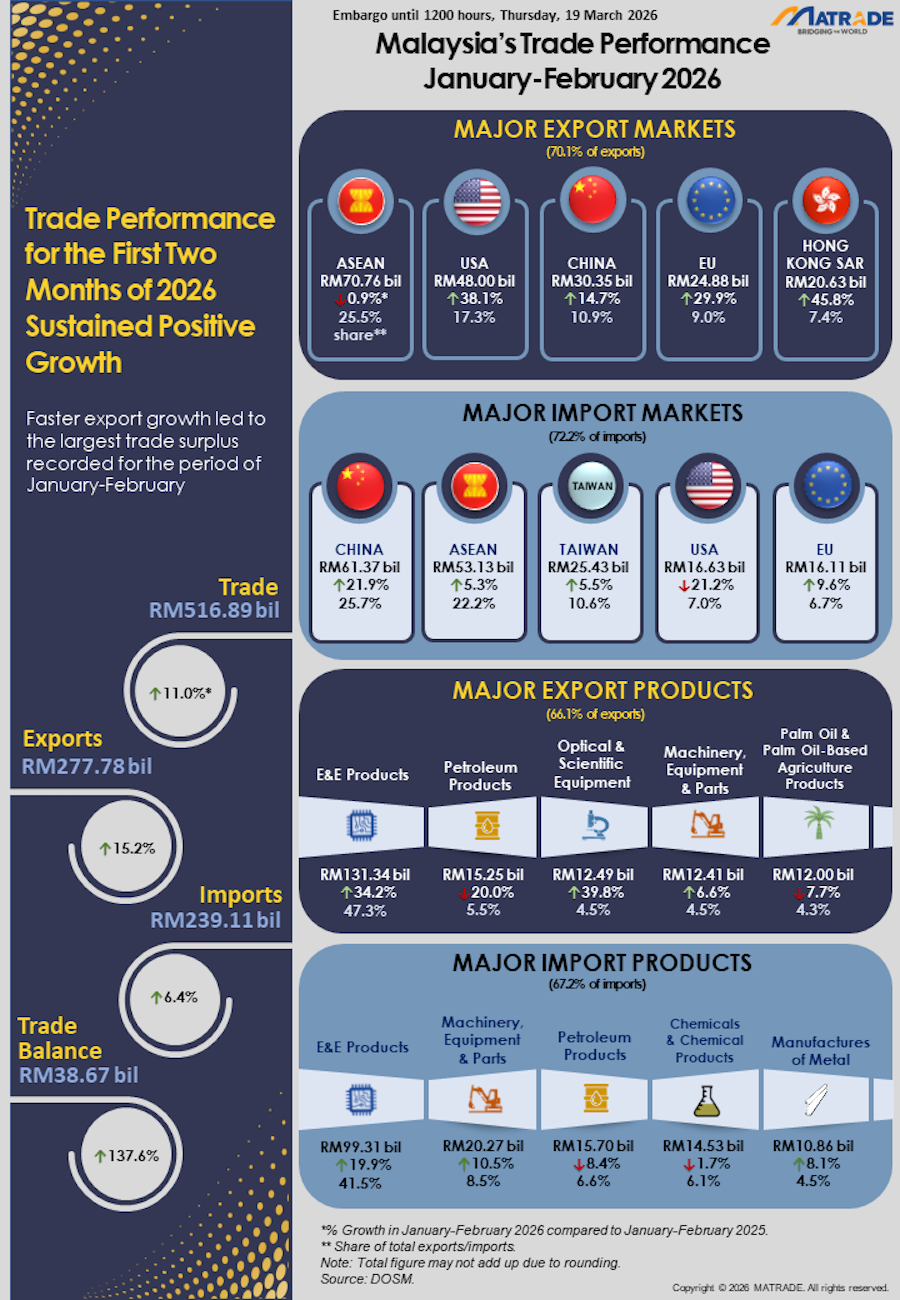
Latest figures released by the Ministry of Investment, Trade and Industry (MITI) show total trade rising 11.0% year-on-year to RM516.89 billion for the first two months of the year, with exports outpacing imports to deliver a trade surplus of RM38.67 billion, more than double the same period last year.
At the core of this performance is the continued dominance of Malaysia’s electrical and electronics (E&E) sector, which surged 34.2% to RM131.34 billion and now accounts for nearly half of total exports. The sector’s strength reflects sustained global demand for semiconductors and high-value components, reinforcing Malaysia’s position within global supply chains.
Beyond traditional markets, Malaysia is also gaining traction across emerging economies. Exports to countries such as Brazil, Mexico, South Africa and Ethiopia recorded strong growth, underscoring a deliberate diversification strategy aimed at reducing reliance on established trading partners.
However, the upbeat performance comes against a backdrop of mounting geopolitical uncertainty, particularly in West Asia, where ongoing conflicts are disrupting shipping routes and inflating logistics costs.
Commenting on the outlook, Abu Bakar Yusof, Chief Executive Officer of Malaysia External Trade Development Corporation, said the surge in trade surplus reflects sustained momentum, but warned that immediate risks remain.
The significant leap in our trade surplus is a clear indicator that Malaysia continues to sustain its momentum… However, our immediate priority now is to mitigate the ‘double-ended’ blockade affecting our cargo,” he said, pointing to rising shipment delays and freight costs faced by exporters.
To address these challenges, MATRADE is mobilising its regional offices across the Middle East to provide real-time intelligence and support Malaysian exporters navigating disrupted supply chains. The agency is also encouraging businesses to diversify logistics routes and explore alternative markets less impacted by geopolitical tensions.
“While we anticipate operational strain, we are positioning Malaysia as a reliable alternative supplier for trade partners seeking to diversify away from regional risks,” Abu Bakar added.
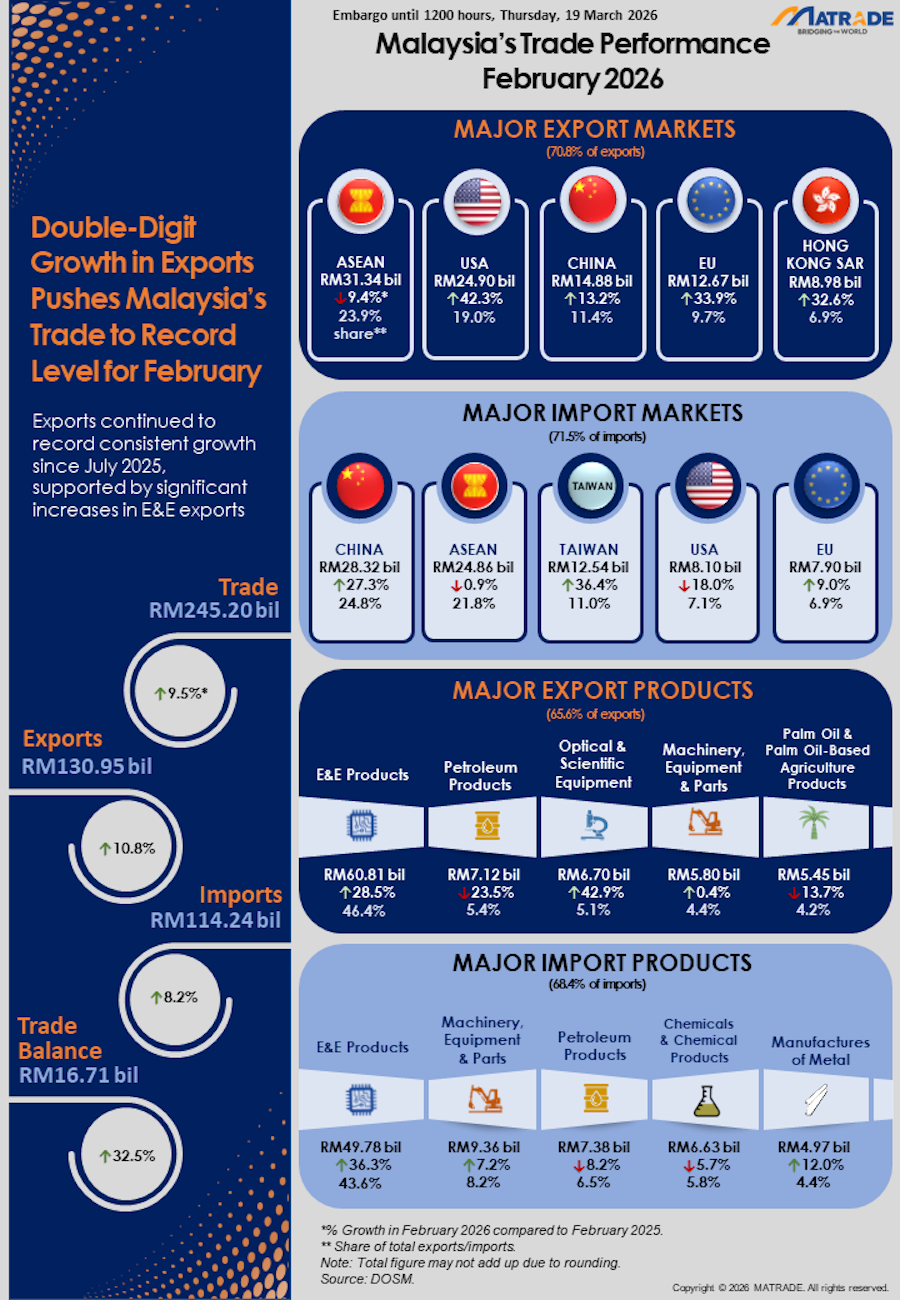
Despite near-term headwinds, Malaysia’s trade fundamentals remain intact. February alone recorded total trade of RM245.20 billion, marking the highest level ever for the month and extending the country’s trade surplus streak to 70 consecutive months since May 2020.
As global supply chains continue to recalibrate, Malaysia’s dual strategy, anchored on high-value manufacturing and market diversification, positions the country to capture new trade flows while strengthening its role as a competitive export hub in Asia.